
Round-Up Ready Alfalfa Wins!

Aug 03, 2020
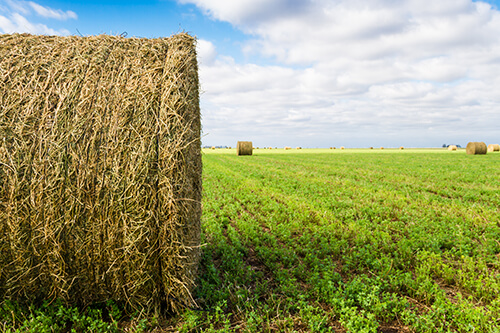

Alfalfa is gaining popularity as a forage, especially Round-Up Ready Alfalfa, because of the feed value per pound. Late August is a great time to establish. It can be challenging, but if you follow some very simple steps it can be a winner!
  1. Choose the right location.
Alfalfa does not like wet soil. Do not plant in a creek or river bottom unless you know it is well drained. Instead, choose an upland rolling field that has natural drainage.
  1. Soil Test! Soil Test! Soil Test!
It’s impossible to over emphasize enough the importance of soil tests. Alfalfa requires a pH of 6.5 or better to thrive. If you take the soil test and the Ph is below 6.0, do not plant! Instead, apply lime and wait until the next spring or fall to plant.
  1. Planting depth is critical.
Alfalfa requires a planting depth of about ⅛ – ¼ inch. Therefore, drilling is not an option. Instead, work up and then firm up the soil. Broadcast the seed, and then firm again. A little seed to soil contact is all that’s needed.
  1. Fertilize by soil test.
Avoid fertilizing until you know you have a good stand. That way you will not be fertilizing any weeds that may appear.
  1. Apply Round-Up or Cornerstone to control weeds.
The last winning and extremely important step is a Round-Up or Cornerstone application when the new alfalfa has three tri-foliates or at about 3 to 4 inches in height. This eliminates any weed competition for the new alfalfa. It does not like competition.
Follow these important steps and you can make alfalfa a winner for you! For more information, contact your local Co-op or Co-op Agronomist.
 

Read More News

Mar 16, 2026

The National Corn Growers Association (NCGA) on March 12, 2026 urged Congress to act immediately to pass legislation that would allow for the year-round sale of fuels with 15% ethanol blends, often referred to as E15, to help offset rising costs related to the closure of the Strait of Hormuz.

Mar 10, 2026
American Soybean Association (ASA) President Scott Metzger, a soybean farmer from Williamsport, Ohio, testified on March 10 before the U.S. Senate Committee on Agriculture, Nutrition, and Forestry regarding the importance of strengthening domestic markets for U.S.-grown agricultural products. 
 
Mar 09, 2026
Tennessee soybean grower Alex Forsbach says that land stewardship and conservation practices are making a positive difference in his operation. He’s witnessed firsthand a significant increase in organic matter alone over the last 10 years and attributes that directly to his use of no-till and cover crops.